Design Notes: The habit that keeps design teams aligned
March 26 2026
4 min read
If you’ve ever opened a design file and wondered, “Why was this done this way?” you’ve already felt what happens when decisions aren’t documented.
Design notes are one of the simplest (and most overlooked) habits in a designer’s workflow. They sit between intention and execution. And when they’re done well, they create clarity, speed up collaboration, and keep teams aligned.
In this article, you’ll learn what a design note is, why it matters, when to write one, and a simple structure you can copy to get started.
Design doesn’t live in isolation.
What you design will be reviewed, built, questioned, and sometimes changed by people who weren’t part of your original thinking—other designers, engineers, product managers, and stakeholders.
A design note bridges that gap.
It’s a short, structured explanation of the reasoning behind a decision. Not just what was designed, but why it’s designed that way—and what someone else needs to know to build, review, or continue the work.
Without that context, people fill in the gaps themselves. That’s where misalignment starts.
In any team with more than one designer, design notes stop being optional—they become essential.
Work rarely stays with one person from start to finish. Designers change focus, go on leave, or hand off flows halfway through. When that happens, another designer should be able to pick up the work without starting over or second-guessing earlier decisions.
Design notes make that possible.
They help ensure:
work can be picked up without a full walkthrough
key decisions aren’t accidentally undone
similar problems are solved consistently across the product
Over time, that creates continuity. The product feels more cohesive because decisions aren’t reinvented in isolation.
Design notes also make cross-functional collaboration smoother.
Engineers get clarity on how something should behave—not just how it looks. Product managers can see how the solution ties back to the goal. Stakeholders can review with context instead of reacting to screens alone.
And instead of repeating the same explanation in meetings and messages, the reasoning is documented once—and easy to reference.
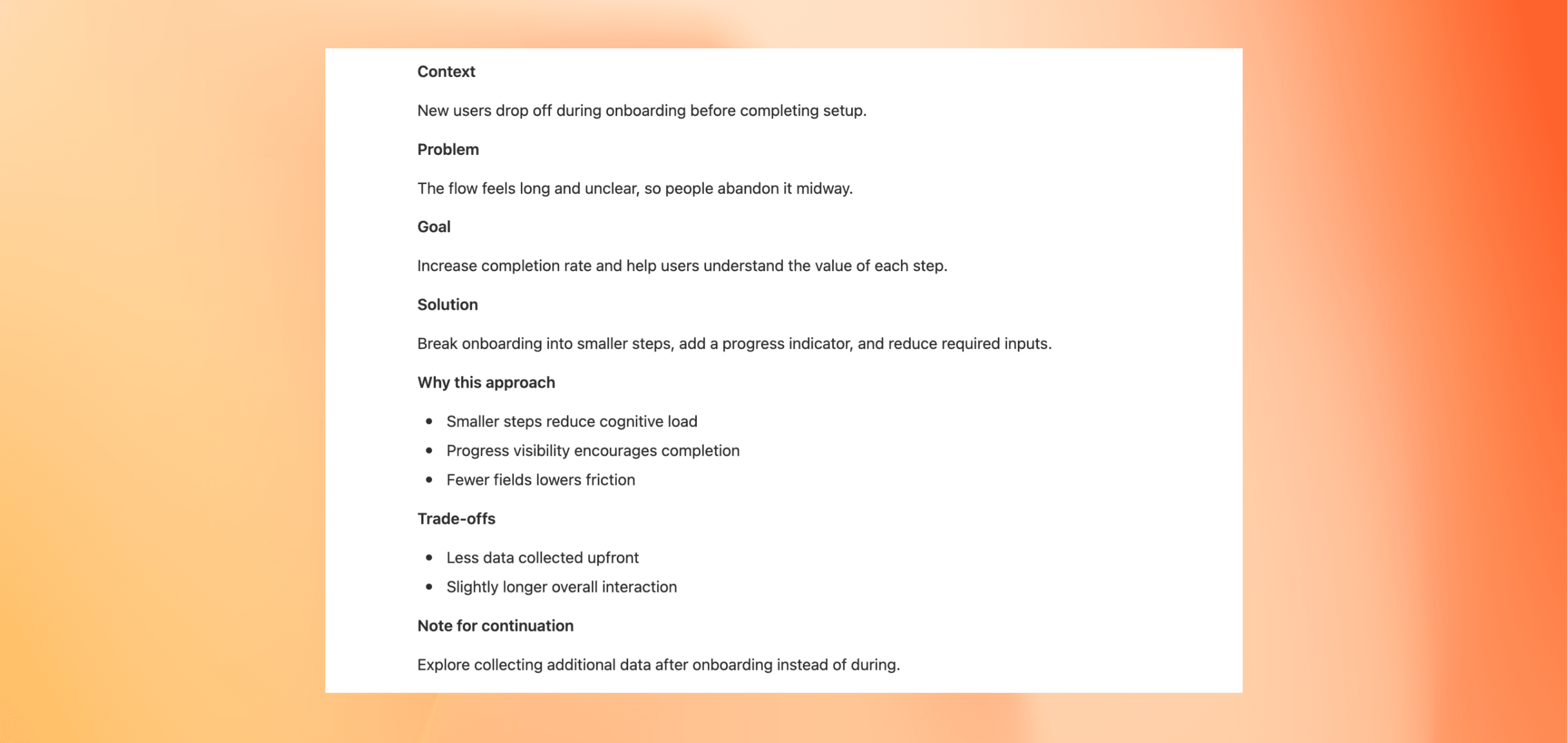
A strong design note doesn’t need to be long. It just needs to answer the right questions:
What problem are we solving?
What are we trying to improve?
What did we design?
Why did we choose this approach?
What trade-offs did we accept?
What should someone know before they continue this work?
When those answers are clear, the design becomes easier to build, review, and iterate on—by anyone on the team.
The writing matters, too.
Keep it clear and direct. Avoid vague claims like “improves UX.” Instead, name what changes and how it helps. Write it so someone who wasn’t in the room can still follow the logic.
Just as importantly, make it easy to find. Put the design note where your team already works—inside the design file, or linked right next to it. If people have to hunt for it, they won’t use it.
Design notes are a small habit with compounding benefits.
They reduce repeated conversations, prevent unnecessary rework, and make it easier for designers to support each other’s work. Over time, they help teams move faster—with more clarity and less friction.
If you work with other designers, this is one habit worth building early.
Where Should Design Notes Live?
Choose a place that your team already uses:
Inside your design file (e.g., a dedicated page)
Documentation tools (Notion, Confluence)
The key is to make it easy to find and reference.
If you’d like a simple structure to get started: